Conference Coverage

Is PASI 100 the new benchmark in psoriasis?


EXPERT ANALYSIS FROM SDEF HAWAII DERMATOLOGY SEMINAR


“These market leaders may not be the most relevant drugs in the current era,” according to the dermatologist.

In contrast, the high-performance biologics – the interleukin-17 inhibitors secukinumab, ixekizumab, and brodalumab and the interleukin-23 antagonist guselkumab – have impressively low NNTs of 2.4-3.6 in order to achieve complete clearance.
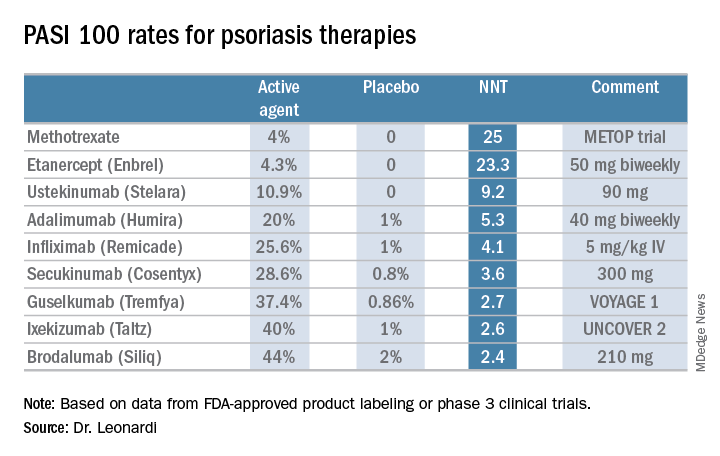
PASI 100 rates for psoriasis therapies
Turning his attention to the more modest goal of achieving a PASI 75 response, he noted that the performance of apremilast and methotrexate is “not that bad, actually, not that bad at all,” with NNTs of 3.6 and 3.2. The market leaders, adalimumab and ustekinumab, are tied with NNTs of 1.6.

“But our IL-17 and IL-23 antagonists are markedly different from all other therapies, with NNTs of 1.3-1.1. With an NNT of 1.1, if you treated 11 patients with ixekizumab, 10 of them would achieve a PASI 75,” he explained.

Recommended Reading

VIDEO: PPACMAN aims to advance the combined rheum-derm clinic approach in the community
MDedge Rheumatology
Xeljanz: FDA panel recommends ulcerative colitis indication
MDedge Rheumatology
Study highlights need to investigate psoriasis treatment outcomes in skin of color patients
MDedge Rheumatology
PASI responses with biologics similar among white, nonwhite individuals, study finds
MDedge Rheumatology
FDA approves IL-23 antagonist for plaque psoriasis
MDedge Rheumatology
FDA approves certolizumab label update for pregnancy, breastfeeding
MDedge Rheumatology
Study using U.K. data quantifies infection risk associated with psoriasis
MDedge Rheumatology
AbbVie, Samsung Bioepis settle suits with delayed U.S. entry for adalimumab biosimilar
MDedge Rheumatology
New PsA questionnaire fails to beat existing early screening methods
MDedge Rheumatology
How to avoid severe diarrhea from apremilast
MDedge Rheumatology