


The cognitive approach is more collaborative and problem-solving than traditional psychotherapy. The therapist questions, and the patient responds. Periods of monologue are uncommon, and dialogue prevails. How the patient thinks is assumed to have an impact on affect (e.g., sadness) and behavior (e.g., withdrawal). The primary focus is on meanings (expectations, beliefs, assumptions, attributions). The therapist often assigns homework to set the expectation that the patient will work between sessions and to structure the nature of that work.
Cognitive therapy is concerned with conscious thought, and the construct of an unconscious is not employed. While the relationship between therapist and patient may be a focus (at times) for the cognitive inquiry, transference is not encouraged, assumed, or interpreted as such.
Standard cognitive interventions encourage the patient:
- to take responsibility for an aspect of the problem;
- to take reasonable risks;
- to consider assertive behaviors;
- to express feelings appropriately.
Key elements The automatic thought is the central feature of cognitive therapy (Table 3). In psychoanalytic terminology, automatic thoughts would be considered “pre-conscious” (accessible but requiring attention to be identified). The early sessions of cognitive therapy are usually devoted to identifying the thoughts associated with the patient’s distress. In dysthymia, these thoughts may concern the patient’s self-view, his or her representation of a significant relationship, or a meaningful situation.
Errors in thinking are another important consideration for the cognitive therapist. In dysthymia, typical errors in a patient’s thinking include:
- polarization (black-and-white thinking);
- personalization (inordinate focus on the self);
- overgeneralization (drawing conclusions beyond the scope of the data).
Case 1: ‘There’s something wrong with me’
Rebecca, age 38, was referred to me by her former psychodynamic therapist for a course of cognitive therapy.
The older of two daughters in a middle-class family, Rebecca said she had been depressed “for as long as she could remember.” Recently, her sister died suddenly of a heart attack. Her mother had died at a young age from complications of hypertension, and her father died 2 years ago of lung cancer. This left Rebecca alone, but that was not the whole story.
Her memories of childhood were dominated by her father’s physical abuse of her mother and his negative and critical commentary about Rebecca. She described her sister, too, as “mean and inaccessible.” Not surprisingly, Rebecca poured herself into schoolwork, and she did extremely well. After college, she passed a challenging CPA exam and began a career in accounting. Although her work was fulfilling, she described “an inner voice” that was constantly belittling and blaming her. Relationships with men always ended badly, with Rebecca believing: “There’s something wrong with me; that’s why I always end up alone.”
Table 3
MAJOR FEATURES OF COGNITIVE THERAPY
|
After each relationship ended with disappointment, Rebecca would overgeneralize: “All men criticize me,” and then personalize: “So, I must be bad.” She had no physical symptoms of depression other than constant low energy and easy fatigue, along with low self-esteem.
Prior to consulting me, she had been treated unsuccessfully with an assortment of antidepressant medications. For 10 years, she had been treated with psychodynamic psychotherapy by a competent therapist with whom she had a “wonderful relationship.” Unfortunately, little had changed.
Comment My diagnosis was dysthymic disorder, 300.40. Rather than attempting another trial with antidepressants, I recommended—and she agreed to—weekly cognitive therapy sessions for an undetermined duration.
Disputation techniques
Once the dysthymic patient’s automatic thoughts have been identified, adopting alternate ways of thinking can bring about change. The therapist’s task is to teach disputation techniques and consideration of options. If a cognitive error is recurrent, calling attention to it may facilitate change.
Figure 1 TRIPLE COLUMN TECHNIQUE
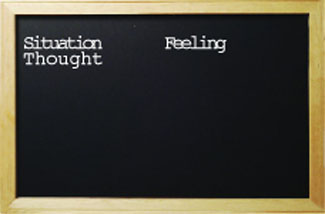
Disputation is typically done in conversation, but some patients with dysthymia learn the process more easily when it is demonstrated visually. One effective approach is the triple column technique, in which situations, feelings, and thoughts are illustrated on a chalkboard (Figure 1).
Rebecca’s intake evaluation was completed in the initial session. I taught her the cognitive method for identifying automatic thoughts at the beginning of session two, using the blackboard to illustrate the relationship between situations and responses.
Primitive animals, I told her, do little more than respond to stimuli. Humans, however, assign a meaning to the situation that will affect their response, whether it is a feeling or a behavior. Cognitive therapy focuses on these meanings. I used her history to illustrate how the model worked.